
Panels
Sit on the roof and generate DC power whenever there is daylight. Rated in watts — add them up and you have the size of your array.
Measured in kWp
PLEASE NOTE: All orders require stock confirmation; collection only, with Gauteng delivery available at an additional charge.
What we do and where we do it.
Solar, explained without the sales pitch
There are only four parts to a solar system and three ways to wire them together. Once you can see where the electricity actually goes, choosing between them stops being a guess.
01 The basics
A solar panel is two layers of silicon with an electric field between them. Light knocks the field into motion, and that motion is a current.
What comes off the roof is direct current — DC. Your house runs on alternating current, so an inverter sits between the two and converts one into the other. That is the whole principle. Everything else is sizing and safety.
The brighter the light, the more current. A panel does not need blazing sunshine: it still generates on an overcast day, just less of it. With the sunlight hours Gauteng gets, making your own power is a practical proposition rather than an experiment.
02 The kit
Sit on the roof and generate DC power whenever there is daylight. Rated in watts — add them up and you have the size of your array.
Measured in kWp
The brain. Converts DC to AC and decides, moment by moment, whether the next watt comes from the sun, the battery or the grid.
Measured in kW
Store what you do not use straight away, so you still have power after dark and through load shedding.
Measured in kWh
Mounting, DC and AC cable, isolators, protection and the labour. Not glamorous, but it is what makes the other three safe and legal.
Measured in doing it properly
03 The flow
04 The choice
Same four parts. What changes is whether there are batteries, and whether the grid is still in the picture.
Panels + inverter. No batteries.
Solar covers what the house is using at that moment; anything short comes off the grid as normal. Cheapest per kW installed, because batteries are the expensive part.
When the grid goes down, a grid-tied system goes down with it. That is a safety requirement, not a fault — an inverter must not keep the lines live while someone is working on them.
Suits a property with a steady daytime load — fridge, freezer, pool pump, office equipment — where the aim is to cut the bill.
Panels + inverter + batteries, grid still connected.
Solar runs the house during the day and charges the batteries. The batteries carry the essential circuits through load shedding and into the evening. The grid is still there for a run of bad weather.
You do not have to back up the whole house. An oven, geyser and pool pump need a very large and expensive bank. Most installations back up lights, plugs, fridge, freezer, router and TV, and leave the heavy loads on the grid.
Suits almost every home in Gauteng. Cuts the bill and keeps you running, without paying for full independence.
Panels + inverter + a large bank. No grid at all.
Everything the property uses has to come from the system, so it must be sized for the worst case: a run of cloudy winter days with every load that could run at once. That means considerably more panels and battery than a hybrid system for the same house.
Where there is a decent grid connection, off-grid is hard to justify on cost. Where there is no connection — or getting one quoted is worse than the system — it is the right answer.
Suits farms, smallholdings and remote sites where a grid connection is unavailable or absurdly expensive.
| Feature | Grid-tied | Hybrid | Off-grid |
|---|---|---|---|
| Cuts your bill | Yes | Yes | Removes it |
| Works during load shedding | No | On the backed-up circuits | Yes |
| Batteries needed | None | Sized to your essential loads | Sized to the worst case |
| Still connected to the grid | Yes | Yes | No |
| Relative cost |
The short answer. If you want to stop losing power, you want hybrid. If you only want to reduce the bill and the house is empty all day, grid-tied is cheaper. Off-grid is for properties without a usable grid connection — it is not an upgrade for its own sake.
05 The method
We work from your actual bill, not a guess. Take the units on it and the number of days it covers — that is your daily average in kWh, and everything else follows from it.
Sized from the daily figure. Daily kWh divided by five gives the kW rating we start from.
Sized to cover at least 75% of a day's load if you want to run through the night without the grid.
Sized to generate the day's load plus 20%, so it keeps up in poor weather and as the panels age.
Every inverter has voltage windows and current limits on each MPPT input. An array that looks fine on paper can clip permanently against the wrong one, so we check it against the specific inverter before we offer it.
When the bill is not enough
A bill gives us a monthly average, and an average hides a lot. It cannot tell us when in the day you use power, how hard the peaks are, or which circuits are the heavy ones. Where the property is unusual, or where the numbers do not sit right, we install a logger and record the real load profile.
It stays on anything from a few days to two weeks, depending on how much the usage varies. It changes nothing in the house and it comes off when we have what we need. What we get back is the actual shape of your consumption — which is what tells us whether the battery should carry the evening peak or the overnight base load, and often the difference between a system that fits and one you have paid too much for.
Send us the units and the days it covers and we will come back with a size, not a brochure.
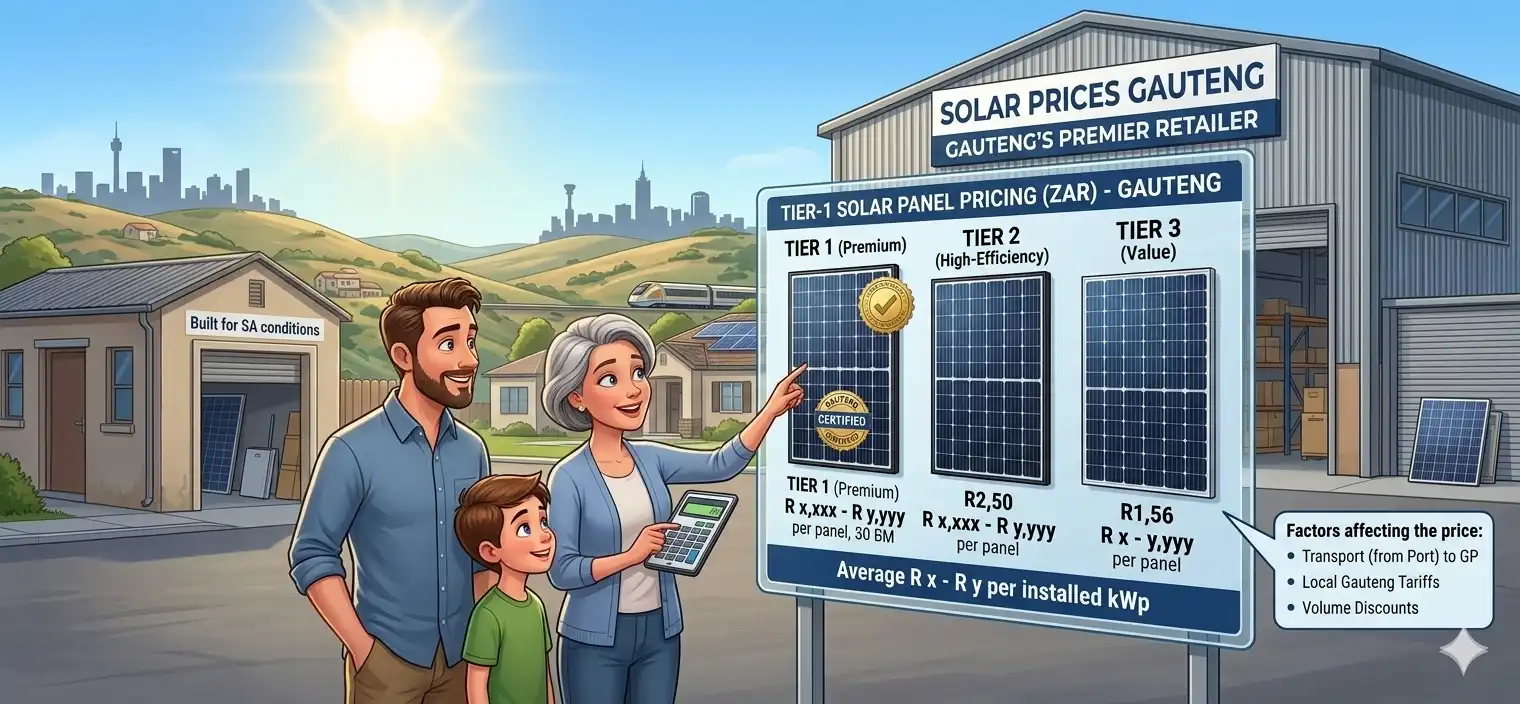
What a solar panel actually costs, per panel and per watt, from our own shop - and why the panels are only about 13% of what an...
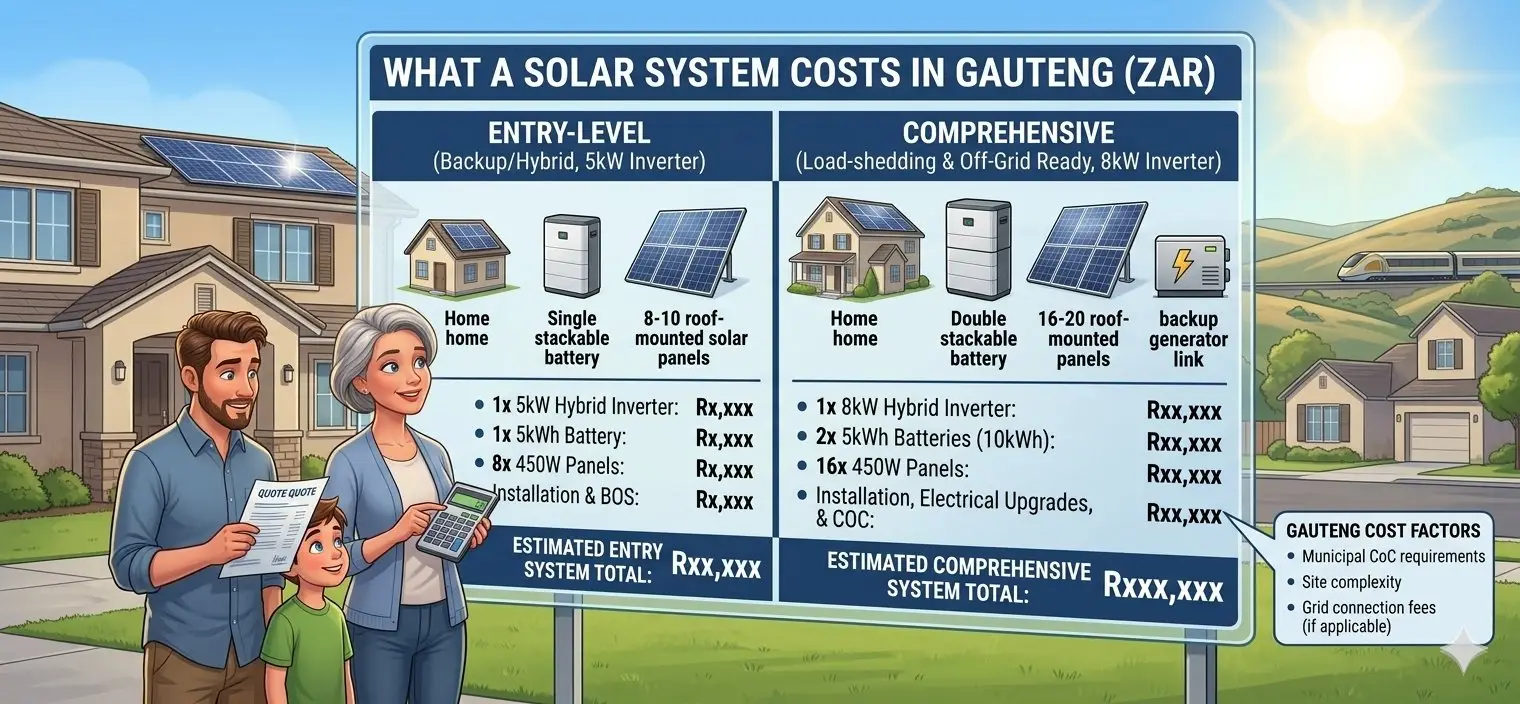
Five real installed prices for Gauteng homes, from keeping the essentials on to running a big house through the night - VAT...
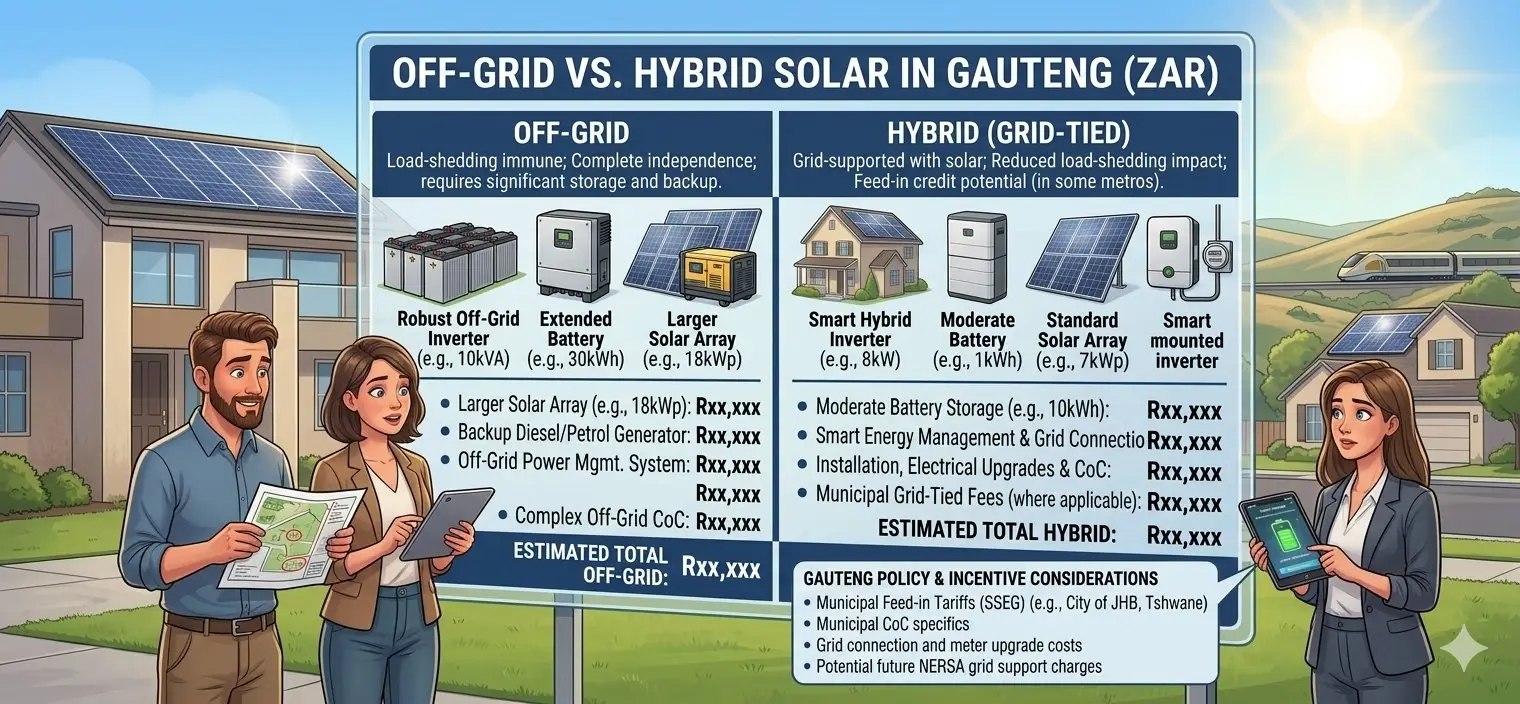
Off grid sounds like the better system and for almost every Gauteng home it is the wrong one. What the choice really costs, and...
We are based in Alberton and travel across the areas below. If your town is not listed, ask us anyway - we often go further for larger projects.